Scotts Miracle-Gro want's "to target the pot market"

According to The Wall Street Journal Scotts Miracle-Gro CEO Jim Hagedorn say's, "I want to target the pot market,"

...There's no good reason we haven't." Yup, you know we have hit mainstream when Scotts Miracle-Gro want's in on the market.

Things sure have changed at Scotts. Back in 2006 Scotts ran ad's in many trade magazines titled, "Jim cares about Independents". I never bought into the phony campaign, writing about it back in 2006. Seems I was proven correct all these years later. The Wall street Journal article tells us, "the company is recultivating its ties to independent lawn-and-garden-store owners, including offering them exclusive products. Mr. Hagedorn strained those ties with a 2009 speech in which he criticized the owners for not doing enough to promote Scotts products, prompting many owners to walk out.  "'I don't give speeches to independents anymore,'" he said." The article also say's, "Targeting marijuana isn't the only way Mr. Hagedorn is pursuing growth outside the national chains. Scotts is also looking to sell more through grocery stores." Yup, Jim loves independents.

Why does Scotts want to get into the marijuana market? According to Jim, "raids on pot-growing operations have turned up Scotts products. Mr. Hagedorn takes that as a good sign of brand awareness, but he fears that some growers would be reluctant to use a mainstream product." Reluctant? Miracle-gro has a lousy reputation among growers. Likely what Scotts will do is buy out an established brand that has a good reputation.

The article continues, "with consumers still cautious about spending, the retailers aren't building new stores as quickly as they used to, making growth for suppliers like Scotts harder to come by. Against that backdrop, Mr. Hagedorn has pushed his regional sales presidents to look for smaller pockets of growth, such as the marijuana market, that together could produce a noticeable bump in sales."

This is quite interesting. I know of some garden center owners who say they would never carry any products that could be used for marijuana cultivation. Will they drop the Scotts line now? When Scotts starts sniffing around a garden category it's already main stream. Once they break the barrier look to other large entities like box stores to jump in.  Yes, very interesting.

You can feel it

Memorial Day Vegie Garden 020 You can feel it.  There is a growing sense that our food supply, while generally safe and the envy of the world, is fraying at the edges. With cost going up, E coli outbreaks, food shortages, etc. it’s enough to make you want to grow your own. It all sound so wonderful. Your garden producing an abundance of organically grown, safe food, harvested fresh for dinner. The problem is the vast majority of people just don’t have the skills necessary to do it themselves.

Where does one gain the skill necessary to grow the families’ food crop? If you have to think of that for awhile, and still cannot come up with an answer here’s what you could do. Start a garden center. Not you typical garden center filled with flowers, shrubs, trees, and lawn seed, but a place where the community can gather to learn the best methods for feeding their families. Every community needs a trusted resource for something this important. If your local Master Gardeners, garden center, or box store are not doing it, I believe you have a business opportunity.

There is a new type of garden center emerging to meet the challenges of feeding our families. It’s something of a hybrid between the old fashioned seed supply or farm supply, and nursery. There tends to be less emphasis on flowers and ornamentals, and more emphasis on edibles. That’s not to say there isn’t a place for nurseries that specialize in flowers or ornamentals. There just won’t be as many going forward. The ones that do make it, like Annie’s Annual’s have built a following for unique plants found at few other places. They have a niche that would be hard to compete with. Since they are the leader in that niche better not to compete with them, but come up with a completely different niche you can excel in.

The niche for us in our area going forward is consumables. Since we are in a rural area having a gorgeous front yard is less important than in other more suburban, or rural areas. It would be a good idea to look in your area of influence and see if the niche for supplying information and supplies for consumables is open. The time is coming when every community will have a trusted resource for this important aspect of our lives. When you are dealing with peoples food supply they tend to become serious gardeners. Serious gardeners listen and learn.

To meet our goal we have started planting fruit trees in our display gardens. We’re dedicating a 25 x 35 area to high density fruit tree gardening. In that small area we will be growing upwards of 20 different fruit trees. Once the fruit orchard is complete we will build a demonstration vegetable garden. We have the space for it and people need to see what it is that we talk about. These demonstration gardens will be used for workshops where you can learn how to feed your family with food you have grown.

There will always be a place for flowers and ornamentals. We are still providing perennials, annuals, shrubs, and trees. We just won’t be carrying the same stuff you get at the box store. Want a bunch of growth-regulated marigolds? Not from us. Need northern California native plant’s, we have them. Need weed and feed? Not from us. Need organic fertilizers that will nourish your plants, we have that. Want to work with an un-interested nursery person who is only working there because they provide medical insurance? Not here. Looking for an enthusiastic expert that really cares about your success, then you have come to the right place. No one else is doing this in our area so we are jumping in. Is anyone doing this in your area? If not, you might be able to build a business around this idea. The “home grown” movement is going to grow exponentially as more and more food chain concerns arise. This is only the beginning.


Quit selling garden stuff

What a pleasure reading Kathy Sierra’s post yesterday at gapingvoid.com. One thing lead to another and the next thing you know, I'm reading blog posts from the mid 2000’s. Her writing is not only timeless, but should be reviewed by anyone who uses social media as a tactic in their PR campaigns. Kathy created a post in 2006  that is still relevant, maybe even more so today. The post is called, “Seven Blog Virtues (for a Global Microbrand).” I love Kathy’s writing as she condenses everything down into bite sized chunks that are quick to read, but lasting in their impact.

Be sure to soak up the last frame of her presentation. “You can do this without a big (or any) marketing budget.” You can “out-spend” or “out teach.” Which method creates Passionate Users of our goods and services? This is the one area where we in the locally owned independent garden center world can shine. We need to quit selling stuff, and start teaching people how to become better gardeners. We need to help create the next wave of "passionate gardeners,". If we do that then we have helped create the next wave of "passionate customers".

Where to use (insert buzzword)

A month ago I wrote a post titled, "I love my new (Insert Brand Here)." It seemed to hit a nerve. Lot's of different brands, bloggers, and others  jumped into the fray. Some thought my analysis of the social media scene in the horticultural world a bit harsh. Over at Hugh MacLeod's Gaping Void Blog there was a guest post today from Kathy Sierra, who Hugh describes as the worlds most famous ex-blogger. Kathy use to have a wonderful blog titled, Creating Passionate Users.  Today's guest post at Hugh's was titled, "Pixie Dust And The Mountain of Mediocrity". Look's like Kathy has many of the same insights, but perhaps explained in a more articulate manner than myself.  The theme's of our two posts are the same however. Check out the graph she uses with the title, "Where to use (insert buzzword)". This is must reading if you are interested in using social media as a tactic in your overall marketing strategy.


Who can you trust?

Over at Fine Gardening there was a post comparing blood meal and Ironite. At first glance the reader might be appreciative of someone going through the trouble to do this comparison. It is Fine Gardening after all and they wouldn't steer me wrong now, would they? The problem is you cannot compare blood meal with Ironite. While it is true they are both fertilizers, they do different things. Blood Meal is an organic source of nitrogen, while Ironite is a micro-nutrient source. The author declares blood meal the winner in his “test”.  I don't think the author intentionally lead us astray. He is enthusiastic and wants to learn  more himself. He just didn't have all the fact's.

Read today’s post by Doug Green, author and former nurseryman. His bio says, “Doug Green is one of Canada’s most-published garden writers with 8 books (paper) printed and over 12 e-books (and growing) in circulation.” Doug is someone who I have conversed with on and off since the beginning of this blog. He is one of the few people who have always told me in no uncertain terms how he felt. Sometimes it wasn't something I wanted to hear, but as time marches onward the value of his thoughts become clear. Doug say’s, “I admit to being guilty in the past of avoiding controversy in the gardening world by either not reviewing some less-than-stellar book or crappy tool. There’s a part of me that just doesn't want the hassle of explaining to an acquaintance that their book didn't appeal to me or a manufacturer that this tool is a total waste of money. Avoiding controversy was far easier than taking on the increasing number of shoddy books or tools on the market.” It seems Doug has had a change of heart. He says, "I've thought long and hard about this entire 'tentative' review thing; and I have to say I’m tired of avoiding the hard truths out there that tools are poor and so are many books (yes, there are some great examples of each.)" He continues, "the systems are set up, I’m in a new frame of mind and there are a ton of readers who want my opinion. You want my 'truth'? You’re about to get it."  We cant wait!

We are being inundated with poor information. It’s not about helping you make informed choices, or becoming a better gardener. It’s about mentioning the brand name as much as possible in your media. It’s about appealing to the brand kings in hopes that they will send you freebies, and put an ad on your web  page.  Yes, there are truthful reviewers out there, but they are being drowned out by content mills and brands set on dominating the conversation. Not dominating the conversation because their products are remarkable, but dominating because of constant PR on various social media outlets. It's as if they say, “If we shout loud enough in the village square people will look at our stuff.” Not because it remarkable, but because it’s promoted over and over again.

As we brace ourselves for a ramping up of these strategies it will become more and more important to find your trusted resource. The place you can go where even if it's not what you wanted to hear, it's the truth. Truth is the "gold" of the web.

P.S. I received a e-mail after this post went out from Steve Aitken, editor for Fine Gardening. He said the post about blood meal and Ironite will be removed. So the link above may not lead anywhere.

Weeks Roses & Iseli Nursery acquired by Gardens Alive!

According to Tipp News Daily and the RHA (Rose hybridizer) Forum, "in a bankruptcy auction held in Wilmington, Delaware, on May 16, IGP (International Garden Products) Acquisition, a newly formed company under common ownership and control with an affiliated group of companies that includes Gardens Alive! purchased the assets of International Garden Products, including its subsidiaries Weeks Wholesale Rose Grower and Iseli Nursery, Inc. IGP Acquisition is owned by Niles Kinerk, who allegedly started Gardens Alive! in his kitchen and garage in the early 1980’s. Gardens Alive is a frequent bidder at auctions of horticultural firms. They own Breck's Bulbs, Henry Fields, Gurney's Seed & Nursery, and Michigan Bulb Company, Spring Hill Nursery, Audubon Workshop, the Flower of the Month Club, and Rocky Meadow Orchard & Nursery. They tried unsuccessfully to acquire Jackson & Perkins Rose Co.

One commenter at the Rose forum said about the move, "I had already feared that. The product side of this is already at that stage (Scotts), and they command the majority of space. Companies like Spectricide, Whitney Farms, and Lily Miller (and some others) compete to a point, but not at the level Scotts does (they umbrella a massive range of products under various names like Vigoro)."

Weeks and Iseli at one time  independent businesses will now join the others at Garden's Alive! We have talked at this blog for years about the fragmentation in the nursery world. As more and more of these independent garden businesses  are swallowed up by these huge holding companies the garden center world will continue to fragment.

A nurseryman's lament

It's a cold, rainy day here in northern California. The perfect opportunity for those of us in the nursery business  to contemplate the future of our trade, and then write about it. The following is a post from Don Shor, a fellow nurseryman who runs The Redwood Barn Nursery in Davis, California. It is a wonderful summation of the "IGC (independent garden centers) vs. Box Store" argument.

"An open letter to the Big Box stores, and other non-garden stores, that sell garden supplies.

When I first moved to Davis to go to college, I went out in search of houseplants. There was a little drugstore chain called PayLess Drugs where they would put out displays of little houseplants. Only problem was, they had no way to water them. So we all learned that within 3 to 4 days they would be half off. And half dead. But we could snatch up some great bargains if we timed our visit right.

As a budding (har!) hort student I found this very amusing. Little did I realize it was going to become an industry standard for plant aftercare at many retail establishments that treat plants as commodities rather than as living organisms.

Those plants you are selling took a lot of resources to get to your store. There are breeders and greenhouse managers with a lot invested there. Lots of water and fuel to grow them and get them to you. Pesticides and fertilizers, and growth regulators, and often careful management of lighting and nutrients to induce bloom.

So the least you could do is keep the thing watered for a few days, and put it in the right place.

There are a few basic practices that we as plant-sellers should abide by. These are really ethical standards for our industry.

The plant should be properly labeled.

It should be healthy, free of pests and diseases.

It should be monitored to keep it free of pests and diseases.

It should be watered as often as necessary to keep it vigorous.

It should be displayed in the light that is appropriate to the species.

What you are selling should be appropriate to the season and to the region.

So when I see poinsettias displayed outside in freezing weather in Northern California;

when I see orchids outside on a west-facing wall in full sun in the summer;

when I see house plants displayed among landscape shrubs;

when I see dead plants that could have lived but for a little water;

when I see blighted tomato seedlings;

when I see summer vegetables being sold in February in the Sacramento Valley;

when I see pelargoniums labeled as azaleas:

I want to turn you in to have your License to Sell Nursery Stock revoked.

So your grower guarantees your plants, and doesn't even charge you for them until they sell? The customer doesn’t know that. The novice gardener believes that you are selling a healthy plant that will grow here, at the right season. Your guarantee isn't an excuse either. Our industry prospers when you sell success. A beginning gardener who fails often just gives up.

So here are a few pointers.

Very few landscape plants will live long inside your store. Just a few days in low light (I know it seems bright, but it isn’t from a plant’s perspective) will lead to etiolation: weak growth with thin leaves and stems that are vulnerable to infection.

Plants that require sun in the garden require at least some sun in your outdoor display. Plants that prefer shade will burn in full sun. My, this seems obvious, but it is probably the most common blunder I see.

Tropical plants that aren't hardy in your region should be clearly identified as such and kept separate from those that are hardy. Perhaps you should sell them as houseplants.  It doesn't matter what the label says. Your display is what matters, and the training you give your staff. The customer is counting on you. If they see it outside, they think it grows outside.

Know your seasonal annuals, both flower and vegetable. I know you don’t actually have in-house buyers any more. The mega-growers are deciding what is stocked, and they make their decisions for an entire region. So those snapdragons you are getting in May in the Sacramento Valley? They aren't going to bloom all summer. In fact, they won’t last more than a couple of weeks in 90 degree heat. Nothing wrong with selling them to someone who wants a quick display SO LONG AS THEY KNOW that.

Diseased plants should be removed immediately. Again, I know they aren’t really your plants. The grower is supposed to decide when they get pitched. But he doesn't really have much incentive to do so, does he? So when there are spots on the leaves, remove those from your display. Remove them from where water will splash the fungus spores onto healthy nearby plants. Maybe put them by the dumpster, or some place in back. I’m kind of sick of explaining the disease cycle to your customers after the fact.

Those rolling vertical display units of bedding annuals and ground covers? I call those disease factories. If you wanted to design a perfect way to inoculate young plants with fungus, you couldn’t do a better job.

Let’s see:

o      low light? check.

o      high humidity? check.

o      poor air movement? check.

o      movement of spores in running water? check.

Perfect. A few bits of Pythium or Rhizoctonia on top, overhead watering, drainage from one flat down onto another, and you have successfully spread seedling diseases across the entire display.

It’s ok. The problems from these diseases don’t usually show up until a few days after the plant is infected.

Please treat your plants and your customers with respect. These should not be disposable commodities. But when I hear that 15 to 25% of them get thrown out by the grower, there are being treated as disposable. That isn't good for gardeners or our industry."

Thank you Don.

Don Shor and his family have owned Redwood Barn Nursery, a small retail garden center near downtown Davis California, since 1981.

Shop local, it does matter

This video came my way through a Facebook post by Kellee Magee. Kellee say's, "if you adore independent retailers and/or crazy artists you MUST watch this sweet video." We love  crazy artists and independent retailers! According to the website storebuyout.com , " When a simple, yet fantastically audacious idea to buy everything in a store was hatched between beers in a Hawaiian hot tub, no one realized just how much it might positively affect someone else’s life." Shop local, it does matter.

[youtube]http://www.youtube.com/watch?v=yjEiDhOYuy8&feature=player_embedded[/youtube]

Better to have waited?

Memorial Day Vegie Garden 009 We planted our tomatoes out last Monday. We'll, most of them. We did plant some earlier, around Mothers Day. To protect them we used Walls-of-water, which you can see in the photograph. They are plastic sleeves that you fill with water and wrap around the plant.  During the day the sun heats up the water inside the sleeves. During night when the temps fall the warmth keeps the plants safe inside their cocoon.  The walls also help deflect any heavy rain and hail that might fall.

After years of trying them I am convinced the best bet is simply to wait until the ground, and air is warm enough to plant. During a year like this one, with all the cold and rain for spring, the walls can hold too much humidity within, and cause fungal problems. When  I took off one of the walls Monday the plant had black spots on the leaves. Hopefully that will go away now that the plant has been sent free from it's enclosure. As far as size goes, the plants are a bit bigger than the new seedlings we brought home.  Other than that I am not sure the Wall-of-waters are really worth the trouble. It will be interesting to see if the new, fresh seedling tomatoes planted Monday catch up to the  wall of water enclosed ones planted on Mothers Day.


Our summer garden is planted

Memorial Day Vegie Garden 019 We spent Memorial Day working in the garden here in the foothills of the Sierra Nevada.

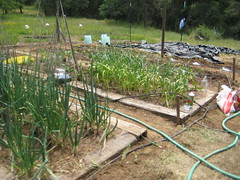
The onion bed is moving right along. We planted red, white, and yellow onions last August. They will be ready when the tops start to fall over, in about one month. Planted Squash, Tomatoes, peppers, melons, and sunflowers today.

Just below the onion bed the peas will grow up the trellis on the left. The trellis on the right has a freshly planted cucumber plant. Just beyond the cucumber is the garlic bed. The garlic will be ready about the same time as the onions. Like the onions, garlic was planted late summer last year. Well worth the wait.

Memorial Day Vegie Garden 021

We are excited that we finally got the majority of the garden planted. It's one of the later plantings we have done, as it's unusually wet and cool this spring. Still need to plant some lemon cucumbers, and zucchini. Maybe one Lemon Boy Tomato and a yellow bell pepper. Some herbs, like basil and maybe some fennel.

All-in-all a productive day.


Biggest indoor plant nursery in San Mateo Co. Ca. files for bankruptcy

According to The Mercury News, Nurseryman's Exchange “the biggest wholesaler of indoor potted plants in San Mateo County and a major Coastside employer, announced Monday that it has filed for Chapter 11 bankruptcy. The family-owned company intends to remain on the coast but is in the midst of ‘restructuring,’ according to CEO Jack Pearlstein." It’s big news as I grew up near this place, and met my wife in Half Moon Bay. It was a landmark along the coast.  San Mateo County is known as the greenhouse capitol of California. According to Rivian Bell a spokesperson for a PR firm representing Nurseryman’s Exchange, “Nurserymen's revenue was $62.7 million in 2010 and $51.1 million so far in 2011, according to financial documents. Bell said the company posted a loss in 2010 but would not say how large it was. Wells Fargo has agreed to loan the company up to $5 million to take care of its remaining debts this summer.”

“Half Moon Bay flower farmer and City Councilman John Muller said he was sad, but not surprised, to hear about the struggles at Nurserymen's Exchange. ‘The nursery business has really changed,’ Muller said. ‘The shipping costs of moving products across the county are really high.’ Most of the greenhouse nursery industry is now based in East Coast states such as Georgia, North Carolina and New Jersey, he added.”

What’s slated to be built on the site? “The grassy parcels, four in all, are zoned for housing subdivisions.” Mr. Muller is correct, the nursery business has really changed.  Just what Half  Moon Bay needs more of, homes instead of employers. It has gone from a working person's town, to a suburb of San Francisco, inhabited by those who can afford the high costs of living there. Kind of a shame, but the way it is.


Should the actions of the parent company matter, Pt.2

When I posted yesterday about Urban Outfitters using the designs of a small business owner with out attribution little did I realize the story would end up at Boing-Boing and The Huffington Post. It shows the power of people talking, and spreading the word. A friend who is a nurseryman commented yesterday. He said, "There seems to be a question of who came up with the design originally. People are stating that these 'I Heart State' pendants have been on the market long before I make Shiny Things came up with the idea. I feel that if you are a small business and you come up with an original idea that you wouldn’t want someone to steal, then you should patent or trademark that idea or product. Being a small business is no excuse to be ignorant of being a good business person and protecting yourself your ideas and your original products.

Trey, if I hybridized a really cool original daylily, let’s say a Red Stella De Oro with variegated folige, and I just started selling it on the market without patenting it, and then all of the wholesale nurseries started picking it up and selling it and then I started crying foul what would you think? You would say 'Wow Keith, I feel bad for you. Why didn’t you patent it? Sucks for you man!'"

Fair enough, but things have changed. Now the small hybridizer like yourself can spread the word about what happened. Here is my answer to my friends comment.

" Yea it sucks. But you know what, I would be pissed off with you. Sure there we’re no laws broken, but still. If that happened to you perhaps you would Tweet your displeasure, and I would pick up on that. I write a blog post on your situation, meanwhile others are Tweeting their displeasure. Next thing you know Boing_Boing has picked up on it. Now I seeThe Huffington Post has picked up the story. Is it right or wrong? Was it right or wrong of these wholesale nurseries to take your hybrid? It’s all grey. The point is, there is something you can do now to get your story out, where as in the past it was a lot harder. Seems that lady is selling her jewelry out as we speak, and a lot of people know about her business now, and know about Urban Outfitters, too."

Right or wrong companies that do stuff that is legal, but a bit nefarious, are going to get called out. How they respond to the that will reflect on their companies for a long time.


Should the actions of the parent company matter?

Remember when Urban Outfitters opened up a retail garden center called Terrain back in 2008? We talked quit a bit about it at the time. Frankly I found then, and still find Urban Outfitters foray into the garden world simply an attempt to cash in on their name. I have been in Urban Outfitters, and while they do have some interesting stuff, it always seemed a bit phony. Doesn't matter, as I am not the target audience and they don't care what this middle aged guy thinks. It's Urban Outfitters and the are just so hip and cool, and if you don't get it your not. Does Terrain’s being owned by Urban Outfitter’s mean anything when the parent company is caught "borrowing" ideas from smaller independent artists? I came upon a Tweet by Stevie in Chicago who owns imakeshinythings.com She designs and makes jewelry, which she sells online through Etsy. She say’s Urban Outfitters stole her designs, and is now marketing them under the Urban Outfitters label. Take a look here and here and see what you think. Of course now she wishes she had copy-righted her designs, but never the less it does seem a bit sleazy.

My question is, do the actions of the parent company affect the other businesses they own, like the garden center Terrain? Should it? I believe this kind of stuff does resonate, and over time degrades the image these companies have worked so hard to build. Suddenly Urban Outfitters doesn't seem so cool.  Terrain?

Looks like Boing-Boing, one of the worlds most popular blogs picked up on the story this afternoon. I wonder if they saw it here? I like to read their blog, so you never know. Never the less this shows the power of The Internet to spread ideas.

Now the Huffington Post has picked up the story.


The spring season so far...

Over at Today's Garden Center they have a report about how spring is going for retail garden centers this spring. Titled, "Spring a Mixed Bag For Garden Retailers" the report shines the light on some bright spot's, and not so bright spot's across the country. Truly a mixed bag. The weather has been the number one reason for most businesses reporting a decline in sales. That coupled with the economy makes for some challenges. Some are doing better than last year. One respondent mentioned the up tick in gas prices helping their business. Seems people are staying closer to home, and working in their gardens.

We have a storm moving in today here in northern California, which is rather late for this kind of activity. People here are just now planting their summer vegetables. We'll have to wait and see how it all unfolds, but so far we are doing alright at our garden center.

Now it's off to go cover the potting soils for the umpteenth time. If the bags get really wet they can get quite heavy. Since I do much of the loading of soils, keeping them dry is imperative.


The fresh wind's of change in garden retail

Where is the future of garden retail? I don’t know about you, but I am so tired of reading about multi-generational,

multi-million dollar a year, Independent Garden Centers (IGC’s). Yes they are to be congratulated for lasting, and thriving in today’s market. It’s just my interest’s lie in the edges, not in the middle where most of these larger operations reside. They are successful, but few new and exciting ideas come from the middle. Give me the smaller, even micro business model where entrepreneurs have to be bold to make it.

The future of garden retail is bright, but not for all. The retail garden centers that are still operating like it was the mid 90’s are not going to be around much longer. You know the ones. Un-interested sale’s staff, boring selection, been there forever, and ain't going to change any time soon. Well they will when they have to have their final sale, but that is still a year or two away. But let’s focus on the bright future of garden retail.

Our nursery group has some heavy hitters as members, but also a huge collection of smaller and micro-sized operations. What I love about these places is they so often have to put it all on the line. They are start-up’s, and if you have ever started a company it’s a scary thing. It causes you to focus on what’s really important, and generally your passion is what carries you through the first few years. We need more passion in our businesses, and in gardening in general.

We just had a new member join our group from Canada. Sarah Hemingway from Sarah’s Kitchen Garden in Ontario has a small nursery that sell’s seedlings for the kitchen garden. She say’s, “I have a passion for growing food and helping other people learn more about it. This business venture is an extension of regular life for me! The more I learn, the more I want to share – with as many people as possible.” Apparently she even has helper monkey’s running around.

She has a couple things going for her that stand out. She say’s, “This business venture is an extension of regular life for me!” Good, because no matter what you think, as soon as you take the dive into this trade it becomes “your life”. She also has, “a passion”, which will serve her well in the years to come. She also wants’ “to share”, which is really the core of what we do. Share ideas, and hope our customers will like what we have shared, and maybe want to take home the items, or ideas we are sharing. It’s a tough business, but it’s heartening to see new people getting involved without the pre-conceived notions of what garden retail is.

I love places like Sarah’s. Our nursery group has many places that are a lot like Sarah’s, and people who exemplify the new era of garden retail. It’s about sharing ideas without worrying whether someone is going to “steal” your idea. It’s about support for each other as we find our way forward in this new retail landscape. It’s about the freshness of a new business, or an older business re-inventing itself. It’s about looking at the other side and having to make a leap of faith, and then jumping. There is no one to catch you if you fall. You can however, get up, dust yourself off, and try a different approach. But you will still need to make that jump. To all the people dreaming of, or actually doing garden retail, here is hoping you at least make the jump. We need more people making that leap of faith. Sometime's, if your lucky,  you  never even have to land.