"Bionic Bee" robots pollenizing orchards?

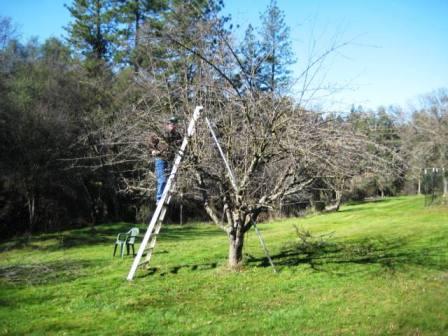
According to China Dialogue, “In recent years, farmers have been forced to hand-pollinate their trees, carrying pots of pollen and paintbrushes with which to individually pollinate every flower, and using their children to climb up to the highest blossoms. This is clearly just possible for this high-value crop, but there are not enough humans in the world to pollinate all of our crops by hand.”

So along come Bionic bees! Wired Online has a story, “Engineers plan to upload bee brains to flying robots.” In the article we read that, “Engineers from the universities of Sheffield and Sussex are planning on scanning the brains of bees and uploading them into autonomous flying robots that will then fly and act like the real thing.” What will they do with these “Bionic Bees”? Engineers say they could “be used for a range of situations where tiny thinking flying machines should be more useful than current technology, which might mean seeking out gas or chemical leaks, or people who are trapped in small spaces. They might even help pollinate plants in places where natural bee populations have fallen due to the still-mysterious Colony Collapse Disorder.”

Bionic Bees pollinating food crops? Yes, and coming sooner than you think  to an orchard near you.

A bit of a stretch

Over at Southern Living Steve Bender known as "The Grumpy Gardener" has written an article titled, "Who wants to kill the birds?" It's about the recent fines Scotts Miracle-Gro received for selling poisoned bird seed.  In the article Steve say's, "Grumpy loves birds. He fills his feeder twice a day. So imagine his shock when he learned that Scott’s Miracle-Gro admitted to selling bird seed tainted with pesticides. Was Scott’s, the maker of a slew of popular lawn and garden products, in league with the devil? To find out, Grumpy paid the company a visit last week at their corporate headquarters in Marysville, Ohio."

It's great that Steve goes straight to the source for some investigative journalism. However, Steve mentions at the end of the article,  "Scott's paid my airfare and lodging for my visit. The Scott’s haters will immediately conclude that Grumpy was bought. Not so. I only agreed to hear Scott’s side of the story with no promise that I would report on it positively, negatively, or at all. Lots of companies in the garden industry send me stuff. If I try a product out and conclude that it’s good for my audience, I recommend it. If I don’t, you never hear about it."

Sure Steve.

Are those for real?

Yesterday The American Horticultural Society posted this picture of Clematis on their Facebook page. By the time I saw it many people had shared and linked to it. The problem? It’s a Photo-shopped picture, which a couple of people noticed and commented on at The Societies Facebook page. Then the post went missing. No explanation, just gone. I left a comment at the site asking what happened to it. The comment remains unanswered.

It’s very easy to be taken in by a photo like this since we are inclined by nature to “believe what we see”. When you remove a picture like this with no explanation one gets the impression that the folks at The Society are wishing it never happened. Why not just leave the photo up and fess up? I and many others had linked to the photo and now those links lead nowhere.

On The Internet what you do never really goes away. When you make a mistakle it’s best to just admit it and move on. Answer curious questions like mine. The pain of getting fooled will soon go away, and everyone can have a good laugh.

Rogue artists and organic graffiti

Back in March we talked a bit about Guerrilla Grafters, a group of people in The SF Bay Area who " collect branches from the California Rare Fruit Growers association or pick up donated branches from backyard gardeners and regional orchards. This bud stock is then grafted onto existing non-bearing trees like flowering pears." This is done without the knowledge or permission of the municipality that often oversees their care. Today in Boing-Boing Cory Doctorow say's, " The Guerrilla Grafters are a group of rogue artists who roam San Francisco, covertly grafting fruit-tree branches onto ornamental trees to create a municipal free lunch. John Robb calls it 'resilient disobedience.'"

Interesting to hear the grafters referred to as "rogue artists" and their actions as "civil disobedience". At Resilient Communities John Robb say's, "there’s a group of gardeners in San Francisco that are spreading organic graffiti across the city." "Organic Graffiti" is a term I had not heard before. So these people are not just wayward gardeners grafting bud stock onto street trees, they are "Rogue artists", spreading "Organic Graffiti" through their city.

This is a important change in the way we look at gardening. No longer just something grandma did to beautify her plot of land, but a movement of "rogue artists" spreading "organic graffiti". I think we will see more and more of this as people plant gardens in their front yards, often against the "rules".

Where do these guerrilla grafters get their inspiration, equipment, and knowledge? It's been quite a while since you could just walk in and buy a grafting tool, or budding tape at your local garden center. Is it bought mail order? Do any garden businesses actively court this trend. My guess is the local hydroponic shops, which are already courting "guerrilla gardeners" have the best chance to reach this group. We'll see.

We can grow that!

Back on September 4th I wrote a post titled, “You Can’t Grow That”. It concerned Scotts/Miracle Gro, and its trade marking the phrase, “You can gro that!” The problem was it was a phrase thought up by CL Fornari, nursery women and author. I wrote, “According to her website, garden writer CL Fornari decided last October to start a campaign titled, ‘You Can Grow That’. Once a week any garden writer who wished to participate would write an article under that heading… Long story short, Scotts/Miracle Gro applied for a trademark on “You Can Gro That!”, after she had broached the idea on The Internet.” Actually, the idea was first broached by C.L. in a "closed" garden center/nursery trade group on Facebook, and not just put out for anyone to see on The Internet.

The good news today is Scotts/Miracle Gro has backed off from the trade marking, leaving CL with her phrase to do as she pleases. Here is the story. It’s quite a turn around and something I wouldn’t have expected from the company. Something tells me it was social media and the avalanche of bad PR Scotts has received over the last year. Whatever the reason it’s nice to see Scotts/Miracle Gro do the right thing. It’s also fun to be a part of something that is changing for the better how we do business in the world of horticulture.

Organizing by not organizing

I read in the latest edition of “Today’s Garden Center” magazine an article titled “Slow Down”. Written by Sid Raisch of The Garden Center Group, it’s an interesting read concerning the changing garden retail landscape. What caught my eye was this. “Slow Retail Is Not Organized. There is no single controlling organization to the Slow movement. Its momentum is created worldwide by individuals who endorse and spread their passion that the Slow way is the better way.” This is the way it’s going to be going forward. Groups of like minded people connecting via The Internet and creating the change necessary to achieve their goals. Often the groups form without any real motivation or goals, but rather a shared interest. Soon themes may emerge that strike the groups fancy, and the group takes on a more proactive role. I see this in our trade group, Independent Garden Centers and Nurseries. Started as a place to just “talk shop”, it has morphed into a dynamic, action oriented group that is literally changing how business is being done in the horticultural world.

So rather than try and come up with a “plan of action”, such as the trade’s current fixation on creating "campaigns", use the “slow down” idea. Using “slow movement” thinking themes and ideas emerge through collaboration that can help the individual nurseries and garden centers who take part. Help the individual nursery do a better job, the customers will follow, and the “trade” will benefit. Actionable ideas that have a direct impact on the business, rather than a campaign which will have little or no effect on individual business. Guess I am just getting a bit tired of campaigns. So often it’s a forced movement that has no real underlying passion.

“Slow Gardening”, that’s something I can relate to. Our customers might ask, “I am already hungry for change in my life; show me how the garden can help. Help me slow down, and reconnect with the natural world. “ We ought to show the customers the benefit of doing business with us. That will really do something for our businesses.

If you’re an owner or employee of a independent garden center or nursery and want to join us go here.

To join our other trade group for nurseries, vendors, and garden media. Go here.

Honest dialogue

One of the goals with starting our Facebook page for retail garden centers, their vendors, and media was to foster open dialogue. So often it seems that the trade news we hear is a bit watered down. You don't get the feeling that your hearing what people really think. Much of the time it seems that traditional media has to walk a fine line between open dialogue, and their advertisers. Not at our Facebook page. When you wake up and check out the site you just never know who will be involved, and what is going to transpire. Today is one of those days. If you a garden center owner, employee, vendor, or garden media (this includes garden blogger's) you can join.  You will need a Facebook account. It is changing the trade as we know it. Don't miss out. Go here to join, and make a difference, and don't forget to make sure that somewhere on your Facebook page it indicates how you are involved in the gardening trade.

You cannot control the message

My last post concerning Scotts/Miracle-Gro's trademarking a phrase thought up by someone else brought us this comment from Robert Woodman, of The British Gardener. "I was in ‘shock and ore’ to read what Scotts has done with trade-marking ‘you can grow that’. I guess this is ‘the taste of a new generation’, but its not ‘M’m M’m good’. As a writer I like to ‘get ready to rumble’ but I want to ‘be all that you can be’ and choose my words carefully. Still this kind of stuff can ‘put a tiger in your tank’. Scotts ‘just do it’ attitude for their marketing doesn’t leave me with a ‘we love to see you smile’ feeling, but ‘it’s so easy, even a caveman can do it’. Sure it’s ‘taking care of business’ to come up with these slogans, but to rip it off from a blogger and prevent others from using it leaves me to think that Scotts is ‘Home of the Whopper’. ‘Have it your way’, we can show disapproval by buying from the competition, words that ‘melts in your mouth, not in your hands’. What ever happened to freedom of speech, doesn’t it extend to the written word as well as the spoken word? As always Trey, your blog is ‘good to the last drop’ when exposing ‘pork, the other white meat’."

It's as if by trademarking someone else's phrase you bring some of the enthusiasm and "mojo" that created the original idea to your business. It just doesn't work that way anymore. These days the customers are often the ones creating the content, via social media. That's the big news. You cannot control the message. People will talk about you, with or without your input.

Thanks to Robert for the entertaining comment.

You can't grow that!

Here is a story that shows just how quickly the horticultural industry in diverging into two different types of business. On the one hand we have smaller, independent garden professionals and on the other hand we have the larger concerns who seem terrified of what the smaller concerns are up to. How else does one explain Scotts/Miracle Gro's recent actions? According to her website, garden writer CL Fornari decided last October to start a campaign titled, “You Can Grow That”. Once a week any garden writer who wished to participate would write an article under that heading. You can read about it here. Long story short, Scotts/Miracle Gro applied for a trademark on “You Can Gro That!”, after she had broached the idea on The Internet.

What’s up with Scotts? At a recent shareholders meeting in January 2012, Chairman and CEO Jim Hagedorn said, "We are making a step change in fiscal 2012 and setting a new benchmark for our advertising investment," Hagedorn told shareholders. "Both our Scotts and Miracle-Gro brands will be supported by completely new campaigns. While we will continue to support individual products in each commercial, we will do so with a consistent approach and message that creates a halo effect for the brands. I believe this is some of the best creative work we have done in years and I am confident it will impact our business – not just in 2012 – but over the longer-term as well."

Then last August Scotts reported, “During today's conference call to discuss its third quarter results, the Company said it expects adjusted earnings for fiscal 2012 to be approximately $2.00 per share and mistakenly stated an expected loss in the fourth quarter of about 40 cents. To clarify, the Company anticipates an operating loss in the fourth quarter which will translate into an adjusted loss per share closer to 60 cents. The Company still expects adjusted earnings per share of about $2.00 for the year.”

Like all of us, Scotts is trying to figure out its place in the changing gardening scene. Its reputation has taken a beating these last few years, and people just don’t seem to want to garden in a way that helped build the company in the past. Garden centers no longer feel it necessary to carry their products, as there are better alternatives now available. Lawns are slowly loosing favor with the gardening public, and lawn care is where Scotts ruled. Finally, through actions like trade marking a phrase, “You can grow that” it shows a certain un-becoming characteristic. It seems destined to alienate itself even further from the very people it would normally count on for support, garden writers and their readers.

Building the virtual trade show

While it would be nice if everyone could attend trade shows like The IGC Show in Chicago, the fact is not everyone can. To help those who cannot make some of these trade shows we developed a Facebook page, IGC Marketplace for vendors and buyers to connect. Have  a service or product you would like to see sold at Independent Garden Centers? Are you a nursery person looking for ideas and products that will differentiate your store from the rest? Our page might just be the answer. The future of independent garden centers is being built in forums and pages just like this.  The IGC Marketplace is the only member run marketplace for the garden trade in the world. Why not give it a try? Go here to check it out. Kind of like a virtual trade show. Plus, we have that really cool logo.

Keep your e-newsletter short and sweet

During our “social media success panel” at the IGC Show an audience member asked how often to send out e-news letters to their fans (customers). They also wonder what was considered too often to send out. They looked at me with doubtful eyes when I said “as often as your fans will let you”. If you can send out an e-news letter everyday that would be great. The lady who asked the question said it took her days to come up with enough information to send out a “proper newsletter”. How could anyone, especially in small business find the time to do that daily?

I receive e-newsletters from a couple of businesses on a daily basis. One of my favorite e-newsletters is Hugh MacLeod of “Gapingvoid”. Hugh has made a living putting his art on business cards. No one else I know of does that. His e-news is usually an uplifting message included with some of his artwork. If the newsletter is the beginning of a longer post it will link to his web page where you can read more. The e-news itself is short and sweet. Here is a link to his daily cartoon e-news. 

I think many of us use “old media” thinking when we use The Internet. The lady at the seminar told us she was putting together a regular newsletter that you might receive through the mail. When we use to send newsletters we wanted to make sure they we’re filled with useful information since postage was expensive, and you might only be able to send out one a month. With e-news you can send out newsletters much more frequently, and therefore make them shorter. Don’t spend so much time trying to stuff “old media” into “new media” technology. Why not send out a quick, easy to read, e-news that can be digested in a couple of minutes? You stay “top of mind” with the audience, since your saying “hello” everyday. You’re also are not asking the reader to spend their morning peering at all the information you put inside of it. Best of all your not killing yourself trying to come up with enough information to fill a "snail mail" newsletter.

Like Hugh say's about his e-news, you'll get "a new cartoon sent out every weekday morning to your inbox. A wee chuckle to start your day off right etc."  Short, and sweet.

Make it easy to connect

Met a marketing consultant/nurserywoman at The IGC Show today. I thought her business cards we're cool. The front is a typical biz card, but it's the other side I liked most. It has all the different way's you can reach her, with the easy to recognize social media logos. It makes it very easy to connect using your favorite platform.  The next time I need more cards, this might be the way to go.

Chicago, the city of flowers and vegetables

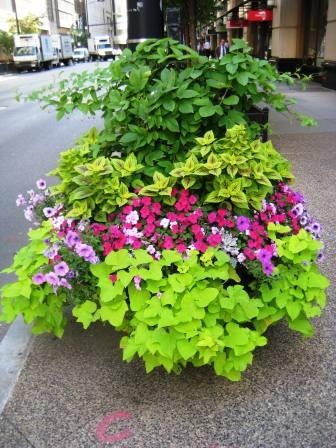
Some cities just know how to put on a show. Chicago has plantings like this all over town. Each one seems unique, and all are kept looking great.

I attended a talk this morning at The IGC (Independent Garden Centers) Show here in Chicago by Rick Bayless, award-winning chef-restaurateur, cookbook author, and TV personality. What's really cool is he  harvests organic herbs, vegetables and other edibles from his home garden  and other city gardens for his restaurants, Topolobampo and Frontera Grill.  He mentions that just twenty years ago there were no farmers markets in Chicago, so he started growing his own! Now,

any top notch restaurant in the city MUST use fresh vegetables grown locally. Yes, they also grow them on the rooftops of the city.

The edible craze will certainly die down, but it will not go away. It's a great opportunity for those of us who sell gardening. We have waited for years for this kind of opportunity. Food and gardening just go together. Having a representative of the trend like Rick will only encourage people even more to "grow their own".

Success by thinking small

Finding businesses and people who have become successful by thinking and staying small is a pleasure of mine. "Small is cool" is about people and business who have found success by traveling  a different path. The competition in the nursery trade is fierce, with the box stores bringing in the very suppliers that at one time we're exclusive to the independent channel. Trying to compete on their scale is impossible for most  smaller garden shops, so we need to find a different way. I see examples of different businesses who have achieved some success, however they define it, by staying true to their beliefs and staying small. Today in SFGate an article titled, "Wine shops find success in thinking small"caught my eye. Wine merchants have many of the same concerns as garden centers might have. We read that, "of course, great wine boutiques have been here all along. But in recent years, those who deliberately chose the small path have seen customer loyalty survive even when the recession pushed a $60 splurge down to $20." It continues with, "supermarkets and large retailers like BevMo have always offered ease of shopping - although at times it feels like I'm staring at a long row of wines that came from the same big spigot. But buying wine is becoming more intimate. Customers are willing to pay for expert curation."

So while the big suppliers like BevMo and Costco will always have a market, these wine merchants in the SFGate article have found a way to survive and thrive by, "...downsizing. Similar to what happened on Bay Area wine lists, buyers decided they didn't have to be all things to all people. Stores could be smaller, which meant lower rents and the chance to do one thing really well."  Some garden centers are starting to see this, and are headed in that direction. Should you?