Embracing change

The interest in gardening has never been more intense, yet we see more and more wholesale and retail nurseries closing. What's up? I don't think the interest in gardening overall is growing, just certain aspects or gardening. Our sales this year indicate the change. The interest in our "little neck of the woods" is in consumables, and color spots. Just try selling Japanese Maples or ornamental conifers and you'll see what I mean. Sod sales are non-existent. Operations that catered to the landscape crowd are doing poorly, while nurseries that cater to the "home grown" group are doing better. Just ask my shrub and tree suppliers. Our sales are way down with these folks. We're happy with the change.  I enjoy helping people become more self-reliant. People will pay for vegetables, fruit trees, and the assorted items that help them succeed.  The younger crowd is especially interested in self-reliance. Generation y and z will spend money on gardening, but not so much the ornamental type of gardening. They are rightly concerned with their futures, and many see the answer in growing their own. This is reflected in magazines where gardening is discussed but not the center of attention. Backwoods Home Magazine, Mother Earth News, Backyard Poultry Magazine, Maximum Yield, etc. It's more about creating a self-reliant lifestyle than creating a "outdoor room."

As our country seems at times to be rudderless, people naturally want to steer their own course. The smaller garden center as a huge opportunity to be the place to help people reach their goals. My sales this year indicate that vegetables, color spots, soils, seeds, and fertilizers are where peoples interests are. People will pay a premium for local, expert information. It's been great to see first time gardeners coming back this year. They we're successful in their gardens last year and want to continue the trend. They do want to support locally owned businesses if you can supply them with their needs, and be there when they need help. The information part is so important. People want to connect with someone they can come to and know they will be steered in the right direction.

What a great time to be a small, locally owned nursery. Small, because you can change course quickly to suit your customers needs. Locally owned, because people want to know that the nursery they shop at has a vested interest in the community.
Is it time to water?

We have been busy this spring! Now that summer has arrived with temps. in the 100F degree range it's starting to slow down. Typical in this business. We will hold a drip irrigation workshop this Saturday at 10 to 11am. Drip irrigation is really big here in northern California where no rain falls all summer. We sell all the parts necessary to install and operate a drip system.During summer our sales are mostly in the fertilizer, pest control and drip irrigation departments. Most folks have planted their gardens and are now in the maintenance mode. Here in the foothills of the Sierra Nevada our soils are lacking in key nutrients for plant health. The addition of fertilizer to the garden is almost a must. At planting time a starter fertilizer high in phosphorus is applied. Our soils lack phosphorus as well as calcium and other minor nutrients. In addition our soil is typically acid, anywhere between 4 to 5.5 in the pH range. At those readings many nutrients are locked up and unavailable for plants to use. Most vegetables need a pH of about 6.5, while some need a lower pH. Having an understanding of pH and how to adjust it are important. To that end we have been  selling pH meters like there is no tomorrow. These $9.99 meters are accurate and quick enough for most people.  The most important aspect is it get's people thinking about their soil and how it affects plant growth.

The meters we sell also have a moisture reading component. After 30 years in the nursery biz you would think I would know when the soil is dry and my tomatoes need watering, not. You can imagine how dry our soil looks with high temps and no rain in summer. It's common for people to over water here since it's so hot outside the plants must need water. So the moisture meter is perfect as once you push the probes into the ground you find out that under that dry soil the soil has moisture in it. I have been able to increase the length of time between watering my vegetables making for healthier plants and a lower water bill. Sometimes having a tool that confirms or denies what you think you know is a very valuable asset. For the customer is confirms what we tell them concerning raising or lowering the pH and it's relationship to fertilizer they will need.

Independents and workshops

Jodee commented in the last post about holding workshops or classes through the summer for beginning gardeners. I think classes or workshops are a great idea for the garden center. There are a lot of people who find gardening interesting but don't know how to begin. Yes, there is all sorts of information on the internet but many people would rather connect and learn from people in the garden. The problem with the internet is there is too much info, and often not localized enough. The only problem with summer classes is the competition with other activities that pop up. I have found that once school gets out in June the attendance seems to drop. Just because the attendance drops does not mean you can't hold classes that will be beneficial for the gardener and nursery.  We will be holding our drip irrigation class in two weeks. By then people will be dealing with the chore of watering their gardens and looking for more efficient ways to water. I think people will respond to most classes if the subject matter is important enough to them.

We've had classes that where very well attended, and classes where NOBODY showed up. The important thing is to just do them and try to make changes that will attract more people next time. Workshops are a great way to connect with the community and gain customers. Often the same people who attend the workshops end up enthused and purchase goods turning a slower day into a more profitable one.

We had a class last week on using native plants for fire protection. Fire is our biggest threat here in the foothills and the proper landscaping can mean the difference between saving or loosing ones home. The class was put on by our native plant wholesale partners, Lotus Valley Natives. A couple of weeks earlier we had Carolyn Singer who authored the book Deer in My Garden speak. The Divide Garden Club and guests showed up and everyone enjoyed her talk. Right as she started we lost power to the workshop building. Oh well, run extension cords and get the coffee machines back up and running! We have had it rain on classes, had the wrong date posted, no one show up, too many show up, etc. The main thing is to just keep doing them.

Become indispensable to your community.  If all we do is carry the same things that the local box stores carry then we are doomed. Find the areas they are not addressing and build a niche. Become the local information center for all things horticultural. There is a real need out there for information presented in a friendly atmosphere. Most people who are developing an interest in gardening are also aware there is so much to learn. They will embrace a place that provides that information on a regular basis. Many also like the idea that we are a smaller operation that really appreciates their patronage. Their hard earned money can make a difference they can see, both at their homes and your store.

What's next?

So now that spring is coming to an end how was your season? We we're busy, but not selling the things we use to sell a few years ago. Consumables are the driving force these days. Grow your own is the new mantra. Soil conditioners, fertilizers, vegetable starts, and seeds all increased. Shrubs, tress, and landscaping are still poor sellers. Small four inch container and jumbo pack flowers sell well. People still want to pretty up the yard, just not with expensive Japanese maples, ornamental conifers and the rest. We are going to position the garden center as the place to go for the stuff necessary to feed your family. The place where soils, fertilizers, and ideas that you can use to create a sense of self sufficiency for your family is what we are becoming.  I am finding it harder and harder to get excited about the next ever blooming hydrangea or Proven Winners introduction.  What I find interesting is how we as communities can create a vibrant culture of self-sufficiency. I see the garden center as a critical component of this movement.  So many people have lost touch with what it takes to grow your own. Having a place where one can re-learn that lost ability will be critical in our communities future. The garden center can be that place.

True garden centers will become indispensable components in our communities, rather than just a place to buy flowers. The industry is gravitating in this direction now. The large box store garden centers are becoming the places for cheap flowers and landscaping. They have the power of size and vendors committed to them that they now own that space. Why compete with them? Independent garden centers can niche out the "grow your own", and "self-reliance" field for themselves. When the information you need means the difference between feeding your family or going hungry who are you going to trust? The box store, or your neighbors at the locally owned garden center? Huge opportunity for independent garden centers.

A small businesses nightmare

While we all wait to see how the Health Care Reform Act will affect us some interesting tidbits are sneaking out. One such tidbit has nothing to do with health care reform (big surprise). According to The Wall Street Journal, "the law also requires all businesses to issue IRS 1099 forms to document every business-to-business transaction of $600 or more. To someone who's never run a business, this may sound like nothing. But Congress hopes to raise $17 billion in added tax revenues and fees from this new mandate. That's hardly nothing." Can someone tell me how this improves our health care? This is huge! Filling out a 1099 form every time we purchase stuff to sell at the nursery.  As the article states, if you don't own a small business it may seem like a small deal, but virtually every time we purchase something for resale it comes to more than $600. Good grief! Running a small business is difficult enough without having to fill out a government form every time we buy something for resale.

This is another example of our present government at work.  Work on health care reform, but while we are at it let's screw all the hardworking small businesses that account for so much of our economy. As if it wasn't hard enough to make a profit lets add a layer of government over site to the equation. Lets make the day just a little longer filling out government forms so we can really go home tired at the end of the day. Of course we will need to hire a few thousand extra IRS agents to wade through this tsunami of paper work. More government!

This is what happens when the people who wrote the law can't even tell us what's in it. We get the pleasure of seeing bits of it float to the surface from time to time. If as a small business owner you wondered how this health care bill would affect you, we are starting to find out. It's not pretty.

Domestic Terraforming?

Wired.com has a Geek Gardening guide to Domestic Terraforming. It's fun to see how gardening, ooops I mean domestic terraforming is viewed by the geeky crowd. As the article states, "Gardeners are among the world’s most charming snobs. Rightly so: As with music and mathematics, the more you know, the more elegant your work. Erudition is valued, and so is a smattering of pretension. If you are a geek looking to put down roots, welcome to gardening. We offer you common ground. Think of it as localized terraforming, if that helps."

Business as usual in the garden department...

The Transatlantic Plantsman, Graham Rice has a post today titled "Don't buy hostas from Home Depot". Graham bemoans the fact that he "found their hosta labeling in complete chaos." He continues, "even allowing for the fact that all the plants were very soft and had clearly been forced, and for the fact that the foliage of young plants is often not typical of mature specimens - well, it's entirely possible that none of the names are right!" This is really not surprising. As a horticulturalist Graham knows the importance of plant names and keeping them straight.  The problem is the corporate mindset at the box stores could care less. As in my last post concerning the re-emergence of tomato blight the box stores attitude is, it's not our concern but our suppliers. Concerning letting the customers know about tomato blight and the possible control methods available the answer is, "the grower, Bonnie, conducts quality control at its centers." I am sure the answer to the hosta mislabeling would also be, "it's our growers responsibility, not ours."

This seems to be a trend at the mass merchants. They are just conduits for plants that are grown by others. If there is a problem they just ship the stuff back to the grower and don't pay. It's called pay at scan. Invasive plants, sick plants, and mis-labeled plants are the growers problem, not the garden center at the box store. Of course the average customer at the box store could care less about these issues. Just give me a pretty plant to stick in my yard.

I am well aware that what we are saying here will have virtually no impact on sales or customers at the mass merchants. Our local Home Depot  is most likely the single largest supplier of plant material in our area. On a typical weekend it is packed with eager shoppers just dying to plant their tomato upside down, buy shade plants (they're called hostas?) or get some bougainvillea (an expensive annual in our area). Oh well, as the operations manager at Lowes commented, "it’s business as usual in the garden department... we have people literally waiting for the [plant] truck to show up."

It's back!

According to LSUAgcenter.com "Scientists at the LSU AgCenter recently confirmed the presence of late blight on tomatoes in home gardens in Terrebonne, Lafayette, Livingston and Tangipahoa parishes. Symptoms include black lesions on stems and petioles, blackening of the fruit, and dark, dead areas on the foliage." Guess where they infection is coming from? "'The disease is probably being introduced on infected transplants, so be sure to check tomato plants for symptoms before you buy them,' said LSU AgCenter plant pathologist Don Ferrin." If you remember last year the tomato season was a disaster due to late blight. According to newsday.com, "late blight, the aggressive plant pathogen that ravaged the 2009 tomato crop in backyards and some commercial farms across Long Island and the northeast, is highly likely to return in 2010, a top plant pathologist said last week."

This is important stuff, as people become dependent on what they grow to feed themselves and family.  "Nick Ranieri, 70, of Mattituck, describes last year's blight. 'I have never seen such a thing happening in my garden,'" said the retired electrician, an Italian immigrant who has farmed and gardened all his life. 'It was very sad, the saddest thing.' His crop of 40 plants was wiped out, a major disruption of the family lifestyle that depends on canned tomatoes through the winter."

We we're on top of this story last year.  According to newsday.com, the blight "was blamed on mass market retail stores that bought plants from wholesale growers, some from the south where late blight pathogens can winter over." Bonnie Plants which is the supplier to Home Depot, Lowes, and other mass merchants was cited as a possible source for the infection. "But Lois Chaplin, director of marketing for Bonnie Plants, the Union Springs, Ala., company that supplies big retailers like The Home Depot and Lowe's, questioned that association. 'Good growers always have precautions in place,' to control disease, she said. 'There are things that happen in nature we can't control, but any good grower will have programs in place to prevent the problem.'"

As a nurseryperson and gardener here is what really bugs me. According to the newsday.com article, "Jim Trowbridge, operations manager at the Lowe's home center in Medford, said it's business as usual in the garden department. Tomato plants and seeds are already on shelves and staffers will recommend fungicides as a preventive measure, if customers ask. The stores aren't taking any drastic measures on late blight prevention, Trowbridge said, noting that the grower, Bonnie, conducts quality control at its centers." Well that makes us feel better. "'Sales have already taken off,' said Trowbridge. 'We have people literally waiting for the [plant] truck to show up.'"

So there is no reason to educate people on what turned out to be a disastrous tomato season for thousands of people? It's "business as usual" at the box stores and Bonnie Plants? No handouts or informational literature to help all the new and returning gardeners about a serious pathogen that could infect their vegetable harvest this year?  No advice on how to deal with this unless people ask? Why doesn't Bonnie plants, or the box stores put together some informational handouts that are at least posted near the vegetable plants?

"Ranieri, the Mattituck gardener, is a case in point. Last month, he planted potatoes from last year's backyard harvest. Told that Cornell advised against it, he said, "'I wish I had known that three weeks ago.'" Yes, if Mr. Ranieri had bought his tomatoes or other vegetable plants from us, or another nursery that cared he would have been given this information. It's about having successful educated gardeners , not making a buck and "business as usual."

This is not just selling plants and moving on. People are starting to depend on their gardens for food. This is agriculture, not just a back yard garden. As suppliers, the box stores and their growers should be doing a better job of educating their customers. Remember this next time someone say's, It doesn't matter where you buy your plants!

Jackson & Perkins declares bankruptcy

Jackson & Perkin's and their parent company Park Seeds has filed for chapter 11 bankruptcy protection. We haven't bought from either company for years. I remember that our sales rep for Jackson and Perkin's use to drive a Jaguar when he made sales calls. I always thought when it came to sales people it was better to drive a car that was equal to or less expensive than the customers cars.

With major wholesale nurseries like Hines, Bordier's, El Modeno, Jackson Perkins, etc., going bankrupt and having to reorganize it's time to recognize the small garden centers and wholesale nurseries that have stuck it out without going bankrupt. Quietly paying their bills and getting up to head to work each day. Bankruptcy happens, and in the business world it is sometimes the only way forward. Get it over with and move on. If you find yourself in that situation it is some comfort knowing that even the big boys with all the talent and assets they posses can find them selves in a bind at times.

Over Googled

We are starting to see an increasing number of people using Google and other search engines to find answers for their gardening questions. My concern is that for some it causes indecision, and/or incorrect action. We had a customer come in the other day who wanted to feed his plum tree. He asked for a 10-10-10, or 12-12-12-12 fertilizer as this is what the "experts" had said from his search. We don't have fertilizer with these numbers, and I don't know anyone in the area that does. Our 16-16-16 fertilizer wouldn't work nor would our organic 5-6-4, according to this man's research. It has to be what the websites he visited said he needed. Yes, I tried to explain that 16-16-16 would be the same as 10-10-10, except you would apply less per instructions. He said that he had spent hours searching for the correct answer and the "real" person (me) was not about to sway his psychic investment in the virtual experts. I wonder if he will ever get his tree fed? Another customer came in and accused us of infecting the inside of his home with aphids from alleged infected artichoke he bought. Rather than come to the nursery and find out what would have solved his concerns he chose instead to search Google for answers. Apparently the cure was worse than the problem, as he now claims all his indoor seedlings died. Being concerned with customer service we would have given him whatever he needed to solve his problems. Advice or product, we would have given it to him for free. Now we have an angry customer. He does not hold the advice he received from Google search as the cause for his loss, but rather us. This despite the fact that we we're never consulted on possible cures.

As more and more people look to Google and other search engines for information I am concerned that many are eschewing the advice of local experts, whether online or not. I love the internet and all the information that's out there. Yet it's important to realize that sometimes the best answers come from "real" people who actually deal with this stuff on a day to day basis.  The best answers come from consulting both the internet and local experts. The local experts can even be consulted via internet, if they have an online presence. Otherwise you might actually have to "talk" to them. Advice on plum trees or dealing with insect concerns can be different from region to region. Advice from New York may not be applicable to northern California.

My advice to the customer who has interests or concerns is to familiarize your self with the subject via the internet. Don't let that be the end however. If you are still concerned, or feel you don't understand what the search has reveled find yourself a trusted local source of advice. Local independent garden center, nursery, Master Gardener, etc. Most have a vested interest in getting you the right advice. Right advice equals happy people equals customer for life. Don't let yourself get "over Googled."

The plant world turned upside down

Had to laugh when I saw this DIY suggestion at lifehacker.  The Topsy-Turvy craze is spilling over into the ornamental market. The project looks like it could be fun. Recycling old containers into upside down planters. The orchid is a great subject, too.

If you don't want to tackle the project yourself you could head over to Velocity where they will sell you the completed project, called a Boskke Sky Planter Classic for just $75.

When the world seems "turned upside down" why fight it?

I am not fan of the Topsy-Turvy. Last year I wrote that, "one wonders how many people who planted a tomato in a Topsy-Turvy will do that again? I can’t think of any one item this year (2009)that so perfectly expresses peoples excitement about gardening, and yet tells of their utter lack of knowledge about gardening. This things just don’t work out here where summer time heat gets in the 90’s and 100 degree F range. They dry out much too quickly, yet I have many customers who bought them (not from us). People still love the idea of a gimmick."

Target closing all 260 of it's garden centers

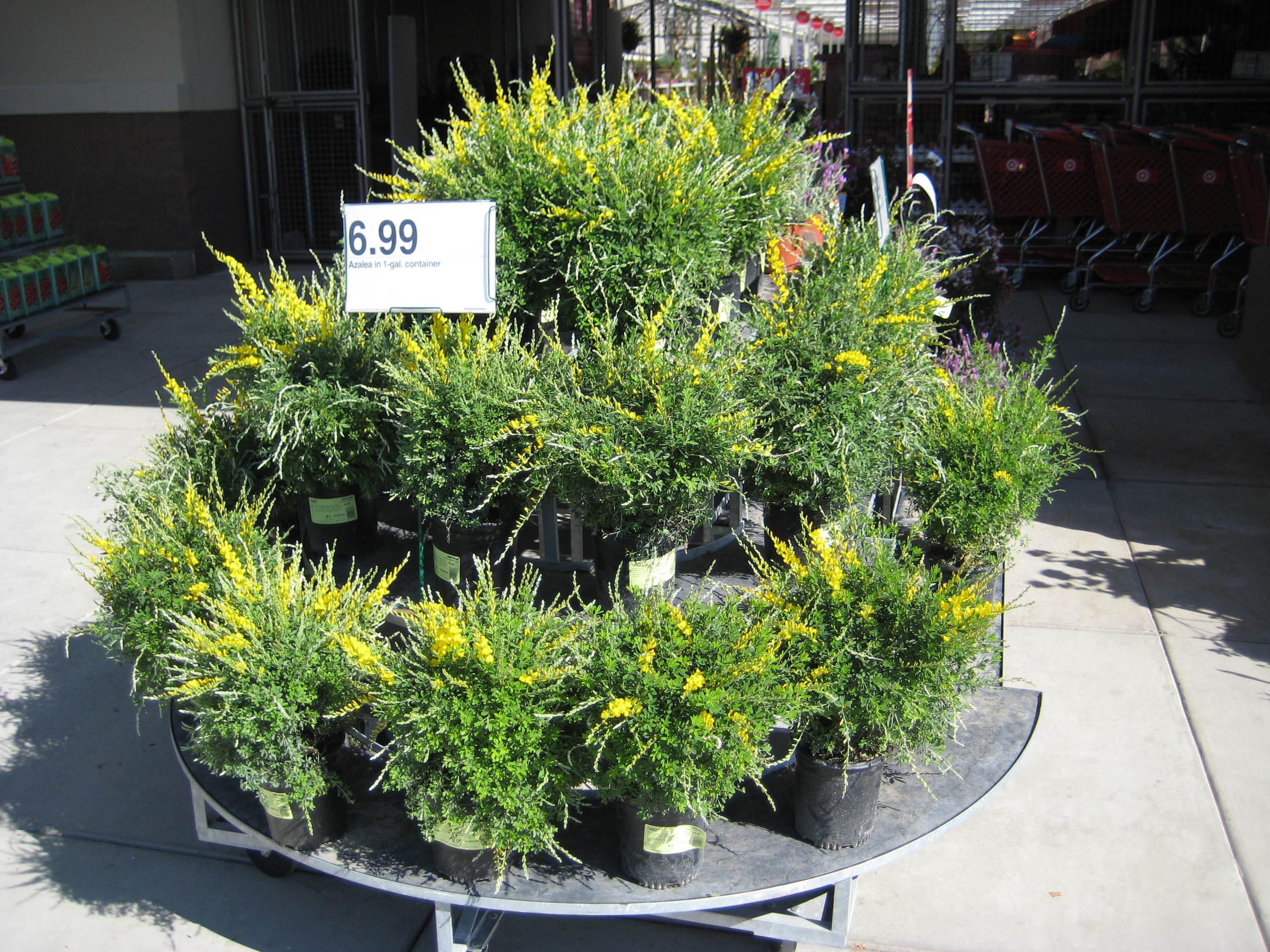
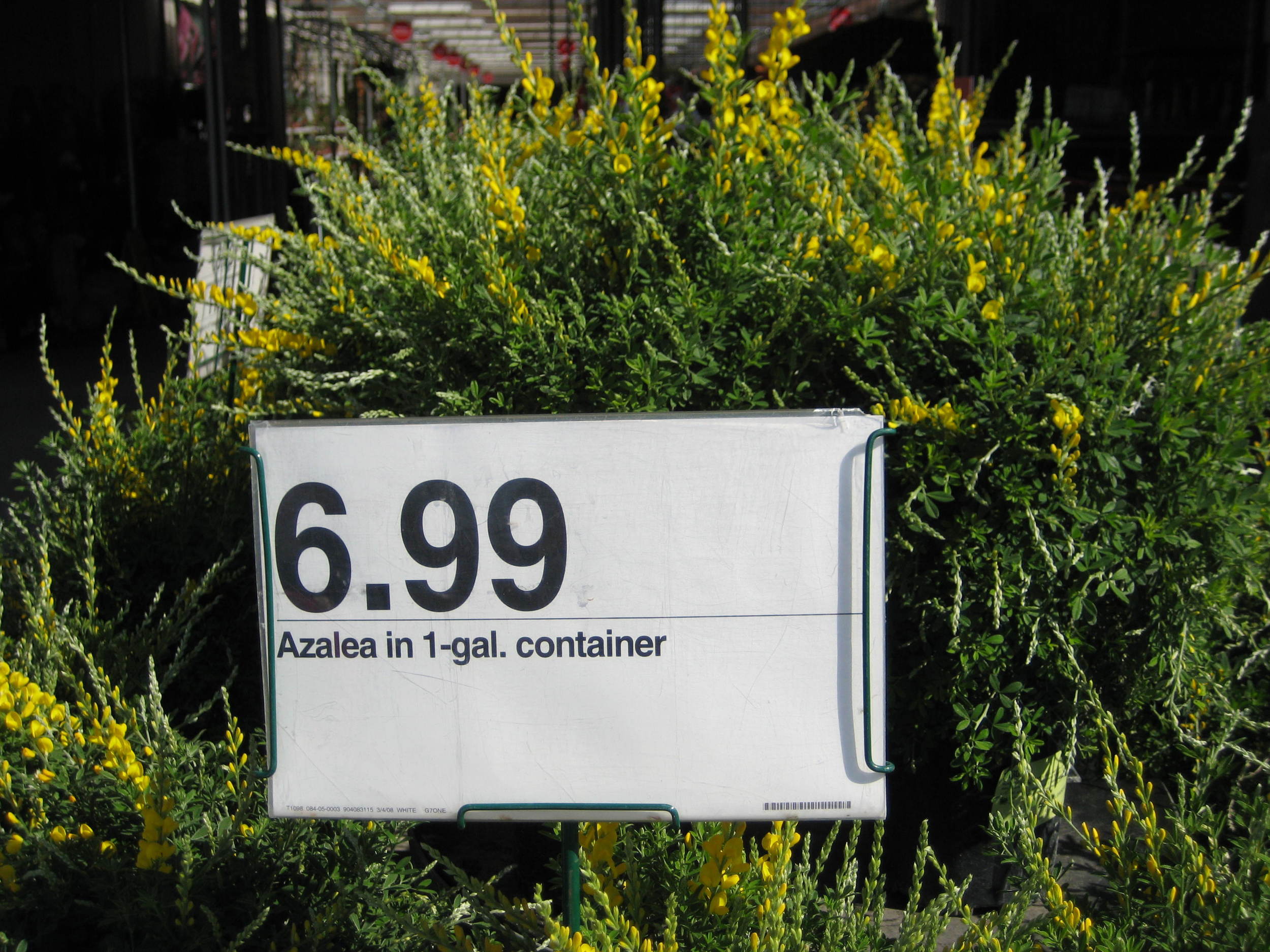
044.JPGLooks like Target is getting out of the garden center business by late September 2010. According to Grower Talks, Target "is closing it's remaining garden centers in Florida, California, Arizona and Nevada." According to spokesperson Jana O'Leary the reason they are closing is "...that the garden centers don't provide significant value to our guests. Also, it's no longer a profitable business for us." In addition, as the two pictures taken at the Folsom Target near here attest, their plant knowledge was lacking. Labeling Scotch Broom as Azalea's does not help. Why we're they selling an invasive plant through their stores? When a chain like Target get's out of the business the suppliers who hitched their wagon to the chain will suffer.  Altman Plants, headquartered in southern California supplies up to 85% of the plants that Target sold. Ken Altman say's, "You know, you never want to take a hit like this..." He say's they are now focusing on "finding other ways to use his production capacity, to save as many jobs as possible for his employees."045.JPG

Who's next? Walmart? I had heard rumblings that they were considering getting out of the business for the same reasons sited by the Target spokesperson, not profitable. Lowe's and Home Depot? How long can they bleed their suppliers on cost and returns? How long can the suppliers keep picking up unsold merchandise and replacing it with new stock? If I was a major supplier to these chains I would start thinking about what to do when they finally decide that running a nursery just does not "provide significant value to"... the "guests".

The exciting field of horticulture?

Here is a video clip of a new vertical wall of greens and flowers at Mario Batali's restaurant, Pizzeria Mozza in LA. He admits there may not be much harvesting going on. He say's it's more of a symbol or "flag" promoting his ideals of "being local, organic, and fresh." Frank  of  New York City Garden commented at my last post about a "egg shaped mini-hydroponic vegetable grower-dispenser." "G.T.G. is a self-contained mini hydroponic greenhouse the size of a vending machine.

Both of these ideas show how much is changing in the world of horticulture. They key to all these innovations are summarized in Mario's comments about being, "local, organic, and fresh." It's a great opportunity for the small businesses out there that deal with the exciting field of horticulture. " Did I just say, "exciting field of horticulture?" Yup.

An eco-system in a shower

Whether you think this idea will take off or not, it's the first time I have ever seen a mini eco-system in a shower. Here at the Pitsenberger house we have a big Boston fern in our bathroom, but this idea takes bringing the outside in to a new level.  eco-system in bathroom

It doesn't matter where you buy your plants?

Over at The Inadvertent Gardener Genie laments "the unscented tomato seedlings of Home Depot." She left the store, "sheepish and sad for the people who would, no doubt, buy those seedlings. I have no scientific backing for this claim, but it seems to me that if the leaves have no scent, it’s likely the tomatoes will have very little flavor, as well." Genie's first commenter responded that she had, "purchased tomato plants (even heirlooms) at Home Depot many times and they were fantastic once I got them home and planted them. (Plants are plants, I don’t it matters where they are being sold..."

Both Genie and I would disagree with that. Genies response is here.

What's important to me as a garden center owner is it will be almost impossible to convince a person who say's "plants are plants it doesn't matter where they are being sold... " to shop at my place of business. These people are actually the majority of people who garden. This explains why the box stores have been so successful. We can try and point out the differences, but really the better approach is to focus our attention on people like Genie. Not only will she be more likely to shop at our business, but if anyone is going sway her commenter that not all plants are created equal it's her.

Reader Marc relates how it's unwise to plant tomatoes too early anyway. What's great is how Marc steers us to Baia Nicchia Farm and Nursery. They grow "gourmet tomatoes and more for the Bay Area." I like their post, "Stick it to the man..." where they extol the virtues of planting at the appropriate time and comment that, " we have seen large stores in the Bay Area roll out tomatoes around Valentine's day, which is insane. These stores don't care about you. They just want you to buy as many tomato plants as possible (some now, and some later when the ones you buy now die). Tomatoes are tropical plants, they don't belong in anyone's garden now!"

So while the majority of gardeners are quite content to shop the box stores there is a smaller group of people who think differently. We really don't need a large advertising budget if we can give them what they want. They will spread the word on their own, one blog post at a time.