A mash-up of gardening personalities.

The great thing about social media and small business is it allows those of us in small business to reach the right people. After all, social media is about being social, and smaller business tends to pull that off better than larger businesses. The very nature of small business is making a connection on a smaller scale. I have never seen such a great opportunity for us to connect not only with the customer, but also with others who can help us with our goals. Most of us in small business use social media in an attempt to find and keep new customers. It's also important as a tool for finding like minded people who can help, but may never be a customer. There are now enough garden centers on line and on sites like Facebook and LinkedIn that an informal network of small and medium garden centers is forming. Got a question about what days to be open or if bulb sales are doing well? Just ask. We use to have to wait until traditional garden business media came out with the results of last years sales. While those same traditional media outlets have gone online and now dispense information much quicker, I find going straight to fellow owners and managers  the best.

Even better than small businesses connecting, we are seeing a mash-up of garden related professionals and amateurs. Garden writers, television and radio personalities, as well as passionate amateur gardeners. Each of these people have the ability to add to the conversation. What happens when your small business has it's own international cadre of experts ready to help?

According to Wikipedia , "LinkedIn is a business oriented social networking site. LinkedIn has more than 50 million users worldwide, of which approximately half are in the United States. 11 million are from Europe. With 3 million users, India is the fastest-growing country as of 2009. The Netherlands has the highest adoption rate per capita, outside of the United States, at 30%." I decided to search LinkedIn for garden related groups and was amazed to see that our group, "Garden Centers, Nurseries, and New Media" has one of the largest memberships, at 590. It also boast the most robust discussions of any other group.

One of the secrets of the group is you don't have to be in the garden center or nursery businesses. There are garden writers, bloggers, media personalities, and members of allied organizations. The members are just like you. They see the power of connecting with like minded individuals and groups using the power of new media. If your interested in joining the conversation head here.
Social media highlights your social skills, or lack of.

I just received the latest issue of a trade magazine where many of the articles deal with various trade shows and events that go on from time to time. My how things have changed over just the last year! Each and every show had seminars held by nursery consultants who have jumped on the social media bandwagon. Just a few years ago we we're told that nurseries really should not worry about or bother with social media, we are now told that your a dinosaur if you don't. Remember that social media highlights your businesses social skills, or lack of. No amount of social media will cover the fact that when I walk in your store you still can't remember my name. Doug Green has an interesting post titled, "Social Media for Garden Centers".  Doug say's the most powerful social media we have is, "'face-to-face' and it works pretty simply (no power cords, no software, no computers) by looking somebody in the eye, calling them by name and giving them the answer they need." He continues, "Want to improve your social media? Take a memory course and learn more of your customer names (heck, never mind 'learn them' – you want to remember them, you want to be able to recall details of your top customers). You spend a ton of bucks on other software – go get an upgrade for yourself."

Social media  is a great way to introduce people to your particular business, but if you lack interpersonal skills it's all for naught. While at Borders Books in Folsom I found myself engrossed in a book, bothering no one. One of their "overly friendly" greeters walked up and interrupted my reading by asking, "if I was finding everything o.k.?" I wasn't walking around looking confused, I had found something just fine all by myself. A lack of face-to-face social skills trumps anything done online. All the money spent by Borders on their social media outreach undone by a well meaning, yet socially awkward moment. I wonder with the advent of all the social media some people are loosing their face-to-face skills?

Narcissus instead of daffodils?

We have all the bulbs at the nursery for half price. Another lousy bulb season, exasperated by poor decisions by the bulb company. For some odd reason they decided to re-label all the daffodils as narcissus. So we get in packages of daffodil bulbs and they come labeled as narcissus. No mention of the word daffodil on the package. So what happens all bulb season? "Do you have Daffodils, I don't want narcissus." Each and every time they asked we would have to explain that narcissus was the botanical classification for daffodils. What a waste of time.

After all the discussions we and others in the trade have had about keeping it simple for the customer, and not over using the Latin names for plants, the bulb companies do the exact opposite. I cannot even imagine the reasoning behind this. As poor as bulb sales have been, and are likely to remain, changes like this can really eat into sales. Why couldn't they just call them Daffodil "Ice Follies." What was the reasoning behind changing the name from daffodil to narcissus? Yes, I know they are actually narcissus, but it's not me they need to market to. Do my customers care that officially daffodils are narcissus? Of course not.

No wonder bulb companies are going out of business, and bulb sales continue to decline. Every year that we have to sell the bulbs at a discount is one year closer we get to not carrying bulbs at all. Well, we will always sell some daffodils since the deer don't eat them. Now if I could only find some daffodils to sell. Narcissus for years has meant "Paperwhites" and other small flowering daffodils. That's what the customer expects.

Lying to make a sale?

In case you don't think the indie nursery business has enough to contend with these days, your not going to like this post  over at Doug Green's  Blog. The post titled, "Six White Lies Garden Centers Tell Customers", lists the various lies that garden centers tell their customers to make a sale. Perhaps in Doug's corner of the world the lies listed are commonplace. I made a comment at the post concerning my feeling on the subject, so there is no reason to go over them here. The more important point in my opinion is apparently this is a belief that is held by others. Read the first comment by Dwayne who says, "True, very true. Of course, if they told the truth they wouldn’t make a sale."

Doug is a garden writer who has a following of gardeners who look upon him as an expert. I really don't have a problem with Doug "telling it like it is", in his part of the country. I have heard this before from others in various areas that don't have quality garden centers. Having done business in Nor Cal for so long it's easy to forget that there are places where the box stores are the best game in town. What a pity, yet it's better to have a good garden center, whether it be box stores or indies.

Read Doug's post entitled, "Big Box Stores versus Independent Garden Centers" for even more good news.

Doug's post paints too broad a picture of the indie garden center business. Not all garden centers lie to make a sale.

The customer as garden center consultant

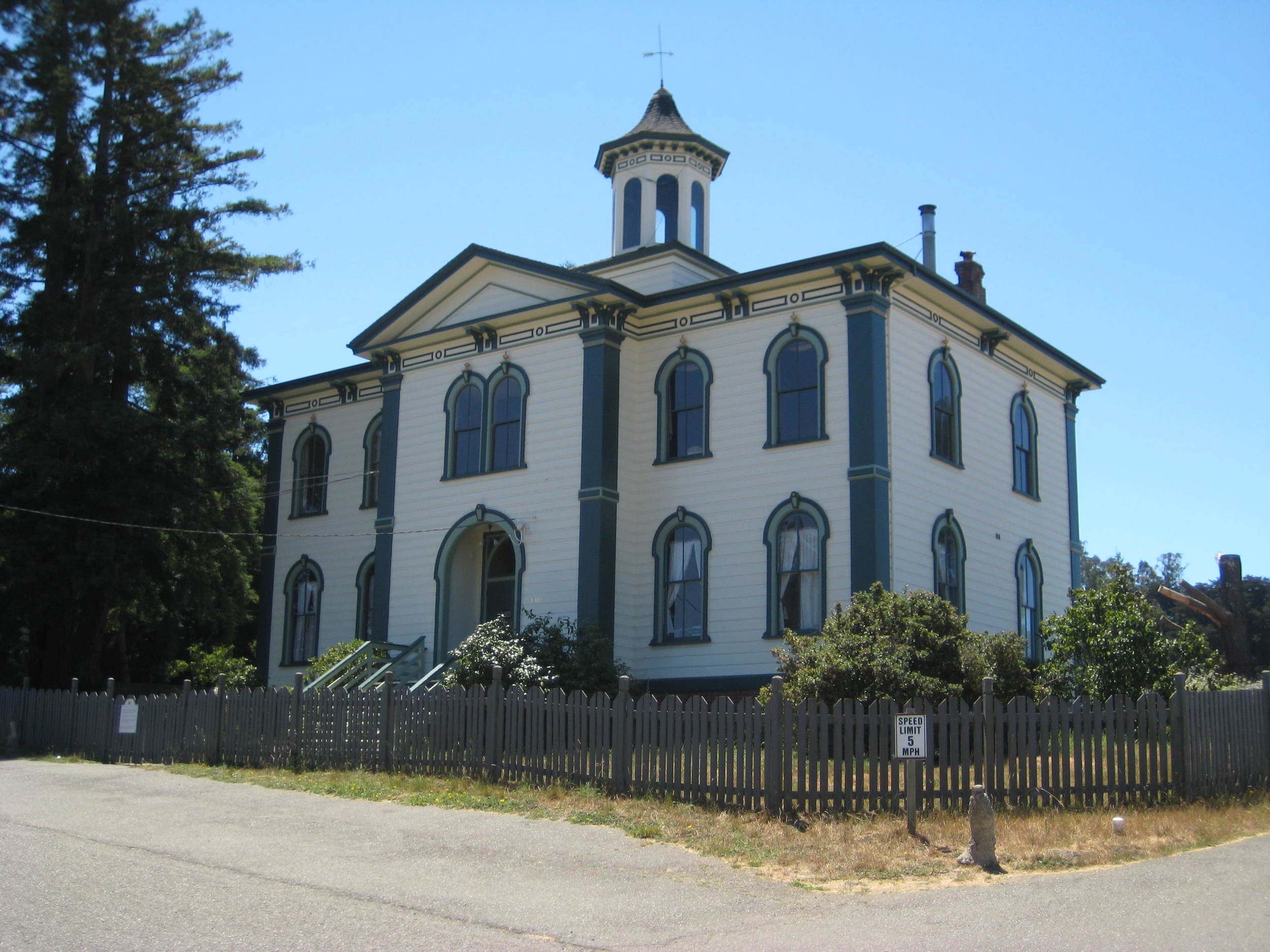
“The Birds” Schoolhouse, Bodega, CA Small business has worked on the assumption that if business is good, then whatever we are doing to earn that business is the correct thing. I would have to agree with that analogy. People do vote with their wallets. In the past some business would put out "suggestion cards" or what not, trying to solicit customer feedback. Now we have social media where, if we do it right, our customers become friends and tell us quite willingly what we should be doing at our businesses. I also love how small garden centers are coming up with ideas to stay viable and flourish. From cafes in the stores, to workshops, special events etc. I received a Facebook comment from one of our customers, Leonard. He commented on this picture of the schoolhouse from Alfred Hitchcock's movie, "The Birds" I had taken on a trip with Monica. Just idol chatter on an interesting picture. So today I get an e-mail from Leonard which said, "Just wanted to through something out to you. When you commented back about Bodega Bay and the movie 'The Birds' a thought came to mind. I know you and your wife are very busy people, but you throw wonderful events at the Nursery. I was thinking what would it be like if you incorporated a movie night into your evening garden event. An old classic like Casa Blanca, Gone with the Wind or an old Walt Disney movie for a family night. I don't know if you know of Iron Stone Winery in Murphys, Ca. They have the old Alhambra Theatre pipe organ and they do silent movies once and a while. Just an idea."

What a fantastic idea. Seems I had read about something like this being done at another garden center somewhere. Does anyone else know of this type of thing being done in other businesses? Who would have though that a winery would do this? Good wineries are always coming up with ideas to  make their places an "event". Like garden centers they have off seasons, and need innovative fun ways to keep their fans interested.The idea is to foster community. People are desperate for activities outside the home that they can enjoy that doesn't cost a bunch. Now I realize that wineries are hoping to sell a little wine while people watch the movie. How this translates to the garden center, I don't know. It just tickled my interest, and that what's really important.

By the way, the schoolhouse in located not in Bodega Bay, the location of the movie. It's in the town of Bodega, a few miles inland from Bodega Bay. Every time I see this picture the tune the children we're singing in the movie comes to mind.

I married my wife In the month of June, Risseldy, rosseldy, Mow, mow, mow, I carried her off In a silver spoon, Risseldy, Rosseldy, Hey bambassity, Nickety, nackety, Retrical quality, Willowby, wallowby, Mow, mow, mow.

If you can't remember the tune, it's at the beginning of this re-done trailer. Follow it to YouTube.

[youtube]http://www.youtube.com/watch?v=4RKOLFxxq5E[/youtube]

Thanks Leonard!

Garden writing, and garden centers

Just five years ago garden writers, and the garden center business we're generally unaware of each others presence.  That's changed, thanks to blogs and Facebook. Among my friends on Facebook many are garden authors, whom just five years ago I wouldn't have known about. This cross pollination is exactly what the garden center business and garden writing business need. The smaller garden centers never had the money to buy advertising or eyeballs in the old media. That was left for the Big Boys, who had the money to get the attention of garden magazines and television shows. That has now been completely turned on it's head. Many garden authors who once worked for major publications now find themselves self-employed. With the internet they have been free to publish what interests them, and not the advertisers. For most, publishing an article on the web does not bring in the money that once was there for those working the major publications. Never the less, the hunger to write continues, and many garden authors now write exclusively for their own web page.

Both the garden center and garden writing businesses are in a state of great change. I think the garden writing business is in even more flux. Just who is a garden author? Anyone writing a garden blog or publishing on the internet, that's who. Not that every one writing a garden blog knows what interesting writing is.  The cream rises to the top, and as such the crowd soon steers it's eyeballs that direction. Once that happens a lot of the interaction that goes on is at social media sites, like Facebook. The blog becomes less important, and the daily interactions that take place are followed on Twitter and the like.  It makes writing a blog more challenging, as so much of the information that was once reserved for the blog is now dispersed via social sites.

A well written blog is still a joy to read. It seems to be the place that receives the most thought, and therefore better writing. I still check the blog feeds first, but head over to Facebook and Twitter for the behind the scenes look. It's these places that have the most benefit for the garden center. It allows more interaction between the store and the"fans". It allows people to 'fan you' without having to comment at the blog. If the fans have something to say outside the subject at hand they can. This is a boon for the small garden center. Fans (customers) are the best way to spread the word. We always knew that good customers where our best form of advertising. Friends telling friends. It's just that now some of our customers have hundreds of friends!

College student + dorm room + garden = future customer

The headline, "College student finds creative outlet in dorm room garden", got my attention. Gee, I wonder what he is up to? Well it turns out Matt Lehman, " has two tomato plants, beans and a cucumber plant doing quite nicely under the artificial lamps he has installed above the 1-by-3-foot wooden box he built." According to The Baltimore Sun, "he is already eating tomatoes. The beans have blossoms. And the cucumber seedling sprouted..." The article continues, "the reaction of his dormitory neighbors has been positive - sort of. 'After we get past the part where they ask me if I am growing marijuana, they say either, 'Wow. Cool.' Or 'You're a nut.' " We talked about hydroponics and indoor growing before. Most of my readers find it to be a bit to esoteric or tainted by illegal activity to be a serious concern in the garden center world. I don't think it is something for most garden centers to be involved in. A lot like water gardening, it takes a comitment of time and resources to make it a profitable venture. It's is still a niche market in the garden center world. A whole industry arose to meet demand while the garden center industry looked the other way. Oh well, that's just what happened with organic gardening back in the 70's. Something that the hippies we're doing and not worth getting involved in. Now it's all the rage, with garden centers asking the "experts" how to sell "green". What I find interesting is the market is filled with young, and middle aged males. Not exactly your typical garden center customer. It would seem that they are into gardening, but they are spending their time and money in hydroponic shops located in warehouses.

This is not an area for most garden centers to be involved in. We decided to pursue it because my customers we're indicating a need for it. I just like looking into the future when it comes to the small garden center trade. It seems we are often caught up in the way business was done in the past, that we don't see the future staring us in the face. That's why I beleive the future for the small garden center is good. Younger people, who have no pre-conceived notions as to how garden centers "should" be run, will propel our industry for years to come. It seem that, "wow cool" and "your a nut" are often synonymous with the future.

Thanks to Sid Raisch for pointing me to the Baltimore Sun article.

It's True!

My question from yesterday has been answered. Greenhouse Grower Magazine confirms that Color Spot Nurseries has purchased El Modeno Gardens Nursery. According to Greenhouse Grower, "El Modeno Gardens will close its doors after Oct. 31 and Color Spot Nurseries is purchasing the operation’s equipment, raw materials and inventory."

It's interesting how the nursery industry is fragmenting. I think once wholesale nurseries decide which "industry" they want to service, the better off they will be. It becomes harder and harder to supply both the chain stores and the independents. You have to focus on one or the other. I think we are going to see even more medium sized nurseries get gobbled up by bigger players, or go out of business.

This is a unique time in the nursery business. No one really know what the playing field will look like in the near future. Everything is up in the air, and the winds are ripe with possibilities.

Color Spot, El Modeno, and the box stores

I have been hearing rumors that Color Spot has bought El Modeno Gardens Nursery. If it is true, Color Spot is emerging as the number one supplier of plant goods for the chain stores in the west and southwest. By purchasing El Modeno, Color Spot moves into the shrub and tree category along with their bedding plant business. This all makes sense to Home Depot and the other chains. By having one supplier for all their plant needs, they can work together to make sure the right plants are grown and shipped to the right stores. When you get as big as the box stores you want to make sure your supplier network is on the same page as you are.

What's to happen to other smaller companies that have decided to service the box stores will remain to be seen. I would be a bit concerned with this development if I we're one of these companies. What happens when Color Spot can sell that juniper to The Depot at a price lower than what you can? Another rumor is companies wanting to service the box stores with plants will have to sell their product through Color Spot first?

The trend seems to be clear. Box stores will have fewer, but larger suppliers of plants and fertilizers. I would have to guess that Scotts and Color Spot have the bulk of the garden business from these chains.  This does not bode well for the myriad of smaller wholesale nurseries who are sitting on a mountain of unsold plants this year.

My guess as to how this will shake out is you have two different horticultural industries. One larger, with the likes of Home Depot, Lowes, Wal Mart, Costco, and others buying from just a few of the largest growers and suppliers like Color Spot, and Scotts. The second horticultural industry is everyone that is left. Smaller and medium sized outfits trying to find their way in the plant world. I believe we will see a lot of these businesses going out of business this year.

While the advantage to the big boys is clear, there is a disadvantage to having only one supplier for a particular category. Remember the late blight this last year? It cost Bonnie Plants millions in sales when infected plants we're found at the box stores, whether the blight originated at their greenhouses or not. So with the power size brings, the downside is equally powerful.

Does anyone have more information on Color Spot buying El Modeno Gardens?

Suddenly hydroponics is going mainstream, in Saigon!

Readers of my blog know we have been discussing bringing hydroponics into my garden center since July 2nd, 2008. Here is a list of articles I have done on the subject since then.  My latest post on the subject was just this week. It seems like the idea is somewhat less than welcome with a lot of my fellow nursery people. I can't blame them, since until now much of the hydroponic business has been done out of warehouses, and not mainstream garden centers. So it is welcome to see people outside of our businesses start to see the benefits of this type of gardening. Over at Garden Rant this article got my attention. Called "Urban Gardening in Saigon" it touches on the very areas we have been discussing. Check out this quote concerning who is doing this most of this urban gardening, "most of them are male, aged above 30".  Why are they doing this? "I accidentally learned from the Internet that anyone can grow sprout vegetable in their homes with simple tools and I decided to grow vegetables myself. The health of my child is the most important thing for me now."

So there you have it. People in Saigon, and the rest of the world are learning about this stuff through the Internet, and they are doing it for food safety. In addition, it's that illusive group of nursery customers known as "males", that are really getting behind this.

You heard it here first.

Garden Centers, Garden Clubs, and New Media

Had a great talk yesterday in Carmichael for the district meeting of the California Garden Clubs. We had people from Lake Tahoe, Truckee, the Sacramento Area, and Foothills.  Talking to this group, and others over the years one theme I have reiterated is to get a web page up. A lot of younger people might join a club, but often the meetings are during the day when people are at work. With a web page people can still stay involved without having to attend the meeting. This group has done a great job with their web page! They even have a page where you can type in your zip code and find a club near you. Entering our zip I see our local club, The Divide Garden Club still has no web page. We are a mountain area that still has areas where there are no cell signals, or high speed Internet.  Never the less they should have web page since it cost nothing to put up a Wordpress, or Blogger hosted site.  They will come around eventually. I am convinced that the way for any small business or group to keep people informed is via a web site. You can supplement it with a Facebook Page, Twitter account, or e-news. The e-news is the most effective way for us to reach out to our customers, who have signed up to receive the news. I use Constant Contact, where we currently send out over 1000 e-news every week or so.

We have talked in the past how conversations are taking place about you, and your business.  You may not even know it! I use Twitter the least. We live in a rural area where the constant give and take of Twitter makes less sense (to me) than in a urban setting. Still, I do check in now and then. For the first time I searched the word nurseryman to see what comes up. I thought my account name was nurseryman, but it's actually goldengecko. Wow, was I surprised! Up came all sorts of tweets concerning my last post on, What is a Garden Center and What is a Garden Center, Part 2. The other interesting thing about these people is they follow, and are followed by thousands of people. Unlike my self, who is a casual user, these are "Sneezers" Sneezers are the people who are much more likely to spread an idea. They are the ones who will spread the word (good or bad)because people follow, and believe what they have to say.

I had no idea that people we're referencing my post in their tweets.  Just realized a few months ago that your suppose to check the @goldengecko page, to see if anyone wants to get my attention. So now I check that daily, but had no idea the other conversations we're going on. Head over to Twitter and search the name of your business, your name, your occupation, etc. What do you find?

Doug Green wrote a good post on why he finds Twitter less than useful for his purpose. Not even sure it's a good media vehicle for our rural garden center. An urban garden center on the other hand should definitely be involved. Of course, by now you know I blog for other reasons than just promoting the nursery. Still don't plan on using Twitter any more than I do currently, but think I am going to go back after this post and type in a few more key words and see what comes up. Being involved in the conversation doesn't mean you have to do all the talking. Sometimes just listening will open your eyes.

What is a garden center?, part 2

Thanks for the responses to my last post. I wanted to address a couple of them, since I have also asked some of these same questions. As to Christian's concerns about an unsavory type of person buying this equipment, I am sure it happens. I wonder if nursery people back in the 70's had the same concerns about the long-haired hippies that we're coming in looking for organic supplies for their gardens back at the commune. Remember, it was not that long ago when "organic" was considered esoteric, and the realm of the " medicinal tomato" growing hippies. "Why carry organic?", nursery people would say. "It's for the hippies, and they will never be as good a customer as the 50 and 60 year old ladies we have now." Victor say's, "hydroponic use will become a distant memory if pot ever becomes legal. Until it does I believe that there is money to be made in 'indoor gardening'. Nothing wrong with selling hydroponics. Herbs and veggies are grown to some extent but the big movement to hydroponics is really about hiding an illegal crop." Hydroponics are used at Disneyworld to produce all the vegetables served in their restaurants. It is the source of "hothouse grown" tomatoes and lettuce you buy right now in the store. Hydroponics is here to stay. The question is about the home market for hydroponics. If all of gardening was about producing a bountiful selection of produce we would be out of business! It's about having a hobby. Most of us garden as a hobby, just like setting up a model train set in the basement. What practical reason does a grown man or women have a model train set? It's a hobby that fires up the imagination, and someone is making money selling model train sets.

Chris say's, "We have the same type of occasional customer in Cleveland. They are always looking for products to take care of their ‘indoor tomato plants’( wink, wink, nudge, nudge!)" So Chris has occasional customers looking for products for their "indoor tomato" plants. What does he sell them? Or are the asked to shop somewhere else? Realizing that there are more of those customers out there in Cleveland, where do they go now for their fertilizers and supplies?

I realize that here in northern California things may certainly be different than the rest of the nation (hey, quit that laughing!). As an example I Googled hydroponics in our zip code. Four pages of hydroponic shops come up in a 45 mile radius. Well over 40 shops! We are not blind to what the different reasons hydroponics can be used for. Any nursery person, or garden center that sells a bag of potting soil could very well be helping someone grow, "medicinal tomatoes", including those 50 and 60 year old ladies shopping at Christian's nursery.

Often the exciting new technologies, and resources that we take for granted start in the fringes of the gardening world. Remember, real change takes place in the fringes. Organic gardening, now all the rage, started with hippies living in the hills growing "whatever". We, in the nursery business pretty much ignored this movement as being "out of the mainstream". Some people saw the potential and jumped on the bandwagon. They are now called "visionaries". "Oh, please tell us how to sell organic fertilizer and pest controls", we ask.

One of the things that keeps me interested in this business is pushing the envelope. When the wizard say's, "pay no attention to the man behind the curtain," I want to look. In an urban setting where land for gardening is sparse, hydroponics will become an important way of producing safe, healthful food. It already is, whether you know it or not. During the winter when people suffer from the lack of light, having a indoor hobby that grows healthy food, and at the same time helps to wipe away the winter time blues is important. Just like the person who spends hours working on that train set in the basement, hydroponics can entertain someone for hours on end.

Hydroponics, like water gardening, orchid growing, home wine making, or growing "wicked plants", is not for everyone. Home Depot and it's like are there to service "everyone".  We need to find the niches that they don't address. That of course, is not for everyone.

What is a garden center?

It seems that often the "new" ideas and products that we sell at the garden center are not new at all. We jumped into the indoor gardening scene over the last year. This happened after I visited a local hydroponic shop in the middle of last winter. While my conventional garden center was in the winter doldrums, the hydroponic shop was jumping. Not only was it jumping, but it had many of the illusive garden shoppers known as males of generation x and y. Our industry is always asking where these people are, and why they don't garden. They do garden, and they are not visiting conventional garden centers! We talked about this a year ago, and the reasons for our entry into this market. Now many of us prefer the outdoors for our gardening. The less involved gardening is with modern technology, the better. That's fine, but there are lot's of people who enjoy growing indoors, and using modern technology to that end. Reading my morning Boing Boing I came across this post about Farms as Skyscrapers. As the article points out, "The concept of indoor farming is not new, since hothouse production of tomatoes, a wide variety of herbs, and other produce has been in vogue for some time. What is new is the urgent need to scale up this technology to accommodate another 3 billion people. An entirely new approach to indoor farming must be invented, employing cutting edge technologies."

This resonates with many people who ask themselves, if it has been done commercially for the last decade or so, why can't the same technology be used by individuals? It can, and is. What I enjoy about indoor gardening and hydroponics's is it engages a customer base that has not been a big customer of conventional garden centers.  It also can become an obsessive hobby that keeps the indoor gardener visiting the garden center time and time again, trying out all the new products and equipment. It's also is mostly a winter time activity which is traditionally a slow time for the nursery.

Like water gardening, this is not an area you can just dabble in.  If you are going to educate and sell indoor equipment you have to get into it in a big way. We are expanding our garden center into two units of a small strip mall in front of the nursery. This will increase our indoor space by about 900 sq. ft.,providing a place to showcase and demonstrate how the technology works. The key in my opinion is to have actively working displays to show just how this stuff works.

Many in generation x and y respond to the idea expressed in the Boing Boing post that indoor gardening, "if successfully implemented...offer the promise of urban renewal, sustainable production of a safe and varied food supply (year-round crop production), and the eventual repair of ecosystems that have been sacrificed for horizontal farming." Even if it is for reasons other than creating a sustainable food supply, it's an area that engages peoples imagination, and an area that traditional garden centers have allowed to be usurped by hydroponic shops that operate out of warehouses. I read in a indoor gardening trade magazine that the indoor gardening industry is recommending that hydroponic shops change their names to something more user friendly like, "garden center."

Did you get that? They want to call themselves garden centers! Not indoor gardening shop, or hydroponic shop, but garden center. You don't think that local hydroponic shop operating out of a store front is a garden center? Doesn't matter what you think! The people using those shops think of them as their "garden center." You just gained a whole lot of competition. Actually, that competition has been there all along. We just didn't know it!

Keeping the government out of our gardens, part 2

We support the Master Gardeners. Just this last week we donated a couple of hundred dollars in plants for their first plant sale. We have had the El Dorado County Master Gardeners come to our picnic grounds at the nursery the last few years for their annual picnic. The idea that somehow my last post was negative towards the Master Gardener program is false.  Just as Don Shor said in the comments, "California already has the Garden In Every School program, a great opportunity for local nurseries to make direct donations of materials and time and reap excellent public relations. I’ve donated to every school in our area, participated in plantings, talked to school groups, all in conjunction with this excellent state program." So have I Don! Why do we need another layer of bureaucracy from the federal government? Gardening is local and having federal programs just seems to me a waste of precious resources. Lester Loam comments, "Do you know the budget situation of Master Gardener programs around the country?" Yea, most likely it's like all of our budgets, under strain. You just have to deal with it the best you can. Lester says, "we’ve got the potential for an incredible increase in customers for seeds, plants and gardening supplies. Those customers need information about how to garden (and a supportive community to help them) or their initial forays into gardening will sour them for the long haul. There go your new customers." We already have had the incredible increase in customers for seeds, plants, and gardening supplies this year. Apparently the word has gotten out, without the federal governments intervention. Lester says, "master gardeners have been doing that for decades, and that’s why the program works." he continues saying that with more government involvement you are, "more likely to see networks of gardeners sharing information about what works in their area." It seems to me that that is what we are doing here, and other gardening blogs right now. In addition there are places called garden centers, run by people like me who are more than happy to fill you in on all your gardening questions and needs. We are local, need your support, and will keep the money here in the neighborhood. The resources are already in place.

I think Frank hit it on the head when he said, "Local govs can do more to get local farmer’s produce to regional markets. Farm policy needs to address water rights/irrigation, organics, subsidies, etc. Please, Fed Gov - I beg you not to consider my five pots of tomatoes agriculture!"

Keep it local.

Keeping the government out of our gardens

This last summer and fall we have seen an explosion of interest in gardening, for many reasons. Concern over food safety, economics, and just wanting to grow better tasting food has fed into the gardening movement. This has been a grass roots effort, mainly at the local level. Now we see a move afoot to involve the federal government in our gardening. Garden Rant had a post today about the efforts of Rose-Hayden-Smith, an expert on the history of the Victory Gardens of World Wars 1 and 2. According to Garden Rant, "Rose also met with folks at the USDA while she was in town and left convinced that next year the feds will implement a 'national gardening initiative', something she has been campaigning for." We are all for increasing the interest in vegetable gardening.  Why after this last year, where people started gardens and gardening on their own, do we see the need for the government in our gardens? The title of the Garden Rant post is, "Victory Garden Historian, 'There is a gardening revolution going on right now.'" The nature of revolutions is people standing up against government involvement in their lives. Why would we want more government in "our revolution?"Rose say's, "I've suggested to new Agricultural Secretary Tom Vilsack via the Huffington Post, thousands of highly-trained volunteer Master Gardeners (who serve under the USDA's umbrella, through land grant institutions) can be called upon to share their expertise with school, home and community gardeners." I thought that's what they already did. We have regular workshops hosted by The Master Gardeners on all sorts of gardening topics. In addition, our nursery puts on regular workshops promoting gardening and vegetable and fruit gardening in particular.

People turned to gardening this last year in spite of the government. They did it on their own, with little help from the state or feds.  Rose says about the Victory gardens of WWI and II, "But my take-away was the breadth and depth of government action promoting the home growing of food, which resulted in 40% percent of American production being homegrown.  Every community had a 'foodshed coordinator' who worked to make sure the right types of food were planted, all coordinated in a big-picture way."

I don't like the sound of that. A "foodshed coordinator" making sure the "right types" of food are planted, "in a big picture way?". Maybe in WWII, but not now. Who decides what food is "right", The Master Gardeners? I, like Rose am encouraged by the interest shown for gardening this year. It was done without government intervention. Why involve them now? I like to garden because it takes me away from all the "big picture" things that are going on in the world. The garden helps us to focus on a smaller picture, what we can do locally to further the gardening cause. Gardening is local. Let's keep it that way.